The Clan and Bad Blintz move from hostility to negotiation
The Amazing Maurice and His Educated RodentsThe Clan and Bad Blintz move from hostility to negotiation when the town’s rats cease to be treated as a problem to drive away and are recognized as a community capable of making terms. The shift is neither a sudden reconciliation nor a promise of affection: it begins with a public encounter, proceeds through competing proposals and hard questions, and ends in a contract and a committee. The new relationship rests on the practical recognition that both sides share a town and will have to live with the consequences of what the other does.
From spectacle to political encounter
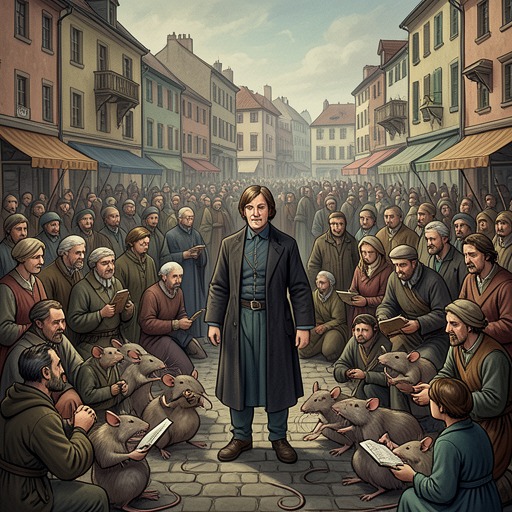
The public meeting is initially framed as entertainment. After Keith faces the piper, he takes the man’s pipe and proposes that they lead the rats out of town together. The piper is to be paid, and the familiar performance is allowed to continue as a show. But Keith’s arrangement does not make the assembled rats his obedient audience: when rats pour up from drains, gutters, and cracks, they are quiet and attentive rather than fleeing. A voice distinguishes them from rats who follow pipers and insists that these are rats the town must deal with. The appearance of an armed rat beside the mayor’s boots makes the change in the encounter unmistakable: the animals are present as a group with its own representatives and claims.
The mayor initially falls back on the category of rats as mere animals, repeatedly questioning whether humans should talk to them. Malicia urges him to listen, and Keith frames the issue as a practical decision rather than a sentimental one. The town can call out dogs and drive the rats away temporarily, but they live beneath its floorboards and will return. They know how to use fire and understand poison; force would not remove the conditions that keep the two populations in contact. Keith therefore directs the mayor toward conversation with the town council and the rats, turning the spectacle into the opening of a political negotiation.
Recognition and competing proposals
Darktan makes the first formal offer on behalf of The Clan. After glancing to Maurice and receiving his nod, he presents the encounter as an opportunity, not a threat. The distinction matters: the rats are not asking to be regarded as harmless or to be granted a favor. They are offering an arrangement between groups whose actions can affect one another. The mayor’s surprise that a rat can speak and think exposes how far the town’s existing understanding must change before negotiation can begin.
Maurice broadens the argument by asking the humans to imagine a town where rats and people make a deal. In his example, a householder could tell the rats that a cake was for them while asking them to leave the rest untouched, and the rats would comply. He presents this as a story about a lucky town, not as a claim that the agreement already exists. The hypothetical gives the humans a concrete picture of cooperation: rules could replace the cycle of pursuit and return. At the same time, the actual agreement cannot be secured by an appealing story alone. The difference between imagining trust and establishing obligations becomes central to the settlement.
The rats’ own ideas of cooperation also carry a warning. Dangerous Beans recognizes the temptation in an offer to join forces and rule the rat world, but asks what such a partnership would mean for the individual rats whose thoughts are being ignored. He sees that a promise of cooperation can conceal domination and mass death. That refusal to confuse unity with submission sharpens the contrast with the later negotiation: the arrangement with Bad Blintz is valuable only if both parties’ interests and responsibilities are taken seriously.
Bargaining over risk and restraint
The mayor asks why The Clan did not poison the town’s wells or set its houses on fire, given that the rats are capable of doing so and have no obligation to protect their human neighbors. Darktan answers in practical terms. Destroying the town would not solve the rats’ problem; it would leave them to move elsewhere and begin the same conflict again. Sooner or later, they would have to speak with humans, and Bad Blintz is as good a place to start as any. His answer is not an expression of friendship. He begins to object to the mayor’s assumption that restraint means liking the other side, then recognizes that the proposed arrangement could still prevent further harm.
This exchange makes restraint reciprocal rather than sentimental. The mayor must accept that the rats have the capacity to retaliate, while Darktan rejects retaliation as a solution that would merely reproduce the conflict. The prospective bargain gives each side a reason to limit its own harmful conduct: the town is not to poison the rats’ cheese, and the rats are not to contaminate the humans’ jam. The comic plainness of those examples does not make the stakes trivial. They name everyday acts of mutual injury that a shared set of rules could prevent.
A contract, not a happy ending
The story briefly imagines humans and rats shaking hands and entering a bright future, but the account immediately distinguishes that ending from real life. A long conflict cannot be ended by a smile alone. The parties require a contract, and the details are substantial enough to demand a committee composed of the town council and most of the senior rats. Maurice joins the discussion, while Darktan sits through hours of argument despite his exhaustion and the pain of his wound. The committee is not a decorative afterthought: it is the mechanism by which a hopeful proposal must become a workable arrangement.
Darktan judges the difficult argument itself as evidence that the agreement may work. Humans and rats are disagreeing over terms rather than returning to unilateral violence. The settlement is described as a beginning, not an effortless solution. It rules out rat pits, traps, and poisons, while requiring the Clan to understand a system of policing and the possibility that rat watchmen will pursue rats who break the new Rules. Darktan expects resistance within his own community; even rats marked by the Bone Rat’s teeth may struggle with the idea that a fellow rat could enforce rules against them. The arrangement therefore places obligations on both sides and creates consequences for violations, rather than relying on goodwill alone.
The eventual prospect is ordinary life: the town can prosper, children on both sides can grow up, and the relationship can become normal. Darktan treats that outcome as worth trying, not as guaranteed. The Clan and Bad Blintz have not become friends, and their agreement does not erase their history of hostility. It establishes a political alternative to that history: both communities must recognize the other, negotiate restrictions, and accept that living together requires continuing work. The decisive change is from seeing rats as an infestation to dealing with them as neighbors who can make and keep a bargain.